



Description
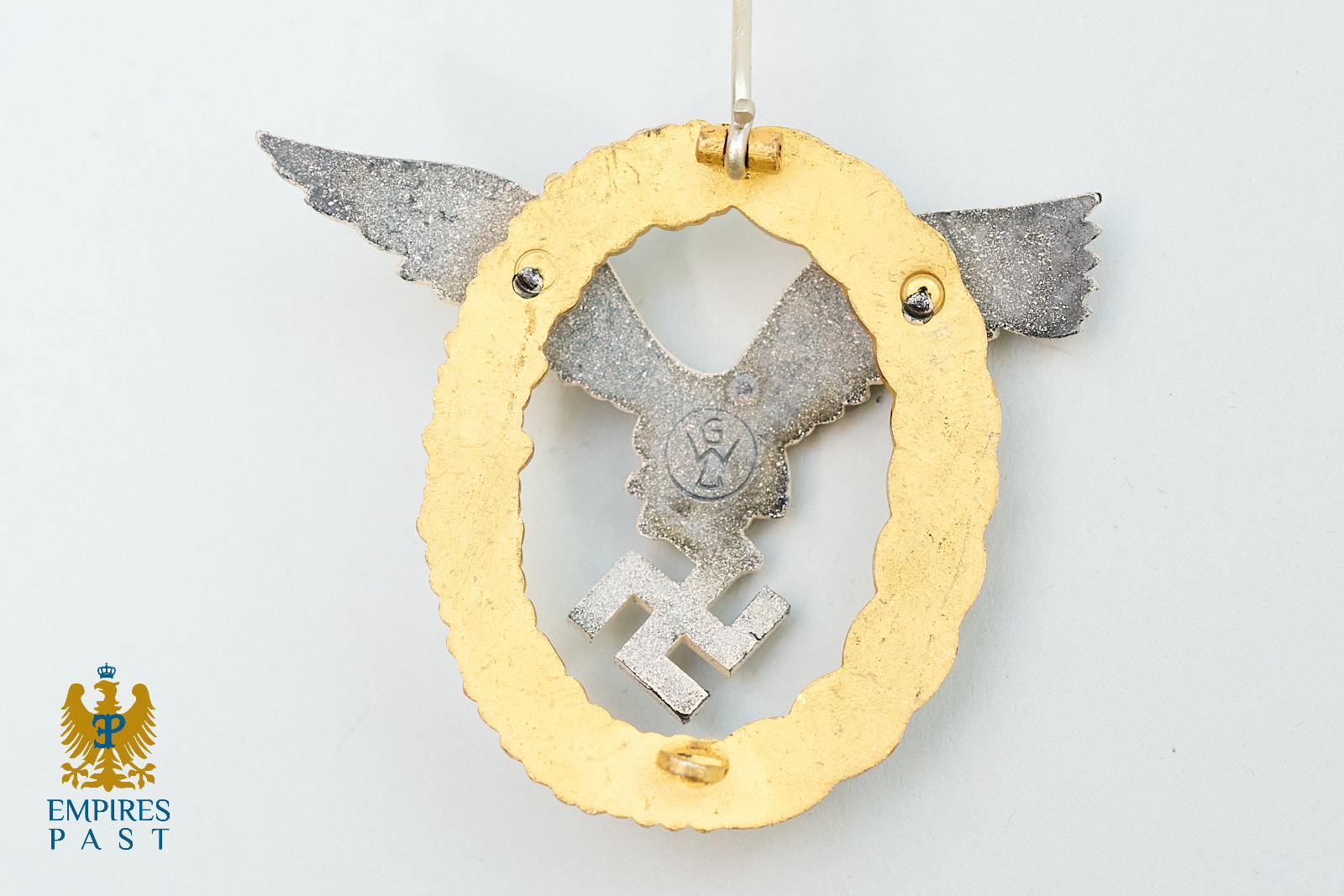
Product Description: Absolutely stunning, mint GWL Pilot Observer Badge. This GWL Pilot Observer Badge is constructed of two pieces of die-stamped tombak. The eagle retains all of its original factory silver-white frosting, with eye popping burnished high relief areas and swastika. The wreath is fire-gilded, also with burnished high relief areas, and remains in the same condition as it did when it left the manufacturer. Both the eagle and the wreath are held together by two rivets. These rivets are textbook in design for what we want to see on early GWL produced Luftwaffe badges. The rivets of the eagle were positioned in drilled holes and then a mechanical punch was used to secure them in place with pressure, leaving the circular depression seen around the rivet itself. A simple block hinge and flat-wire “C” catch are soldered directly to the reverse of the badge, with no repairs. The typical nickel silver pin is also in place and without repairs. The reverse of this GWL Pilot Observer Badge is maker marked with the firm’s trademark, the GWL initials inside a circle. Light patina can be seen to the reverse of the badge, due to the high silver content in the plating. Of all the makers of the Pilot Observer, The GWL Pilot Observer Badge, when found in mint condition, has arguably the most attractive and durable finish types. This badge would make an excellent addition to any collection, wether beginner or advanced.
Historical Description: The Luftwaffe Pilot Observer Badge was instituted by head of the Luftwaffe, Hermann Göring, on January 19, 1935, to replace the earlier Pilot Observer Badge known to most collectors as the “Air Crew” badge. It was among the earliest qualification badges introduced in the German Wehrmacht, and was worn by all qualified pilots in the German Luftwaffe. The design of the badge featured a large swooping silvered eagle, clutching a large German national swastika emblem, surrounded by a wreath of golden oak and laurel leaves. The badge was normally presented in a blue hinged case, but later in the war was issued in paper packets and boxes. It was worn on the upper left uniform pocket. A cloth version was also authorized for field use. In the nearly ten years from the introduction of this badge, to the end of WWII, the manufacturers of these awards made many subtle changes to the features of the designs. Some companies, like Juncker, Assmann, and Deumer, had early first pattern badges which looked completely different from their later produced pieces. Pilot badges were made of aluminum, nickel silver, plated Tombak, and zinc. The eagle was always a separate piece, riveted to the wreath, with different manufacturers using different rivet designs. As the war progressed, and dies wore out, many makers produced badges with subtle changes. All these changes, over time, opened up a large spectrum of variation collecting for Luftwaffe badge collectors. Early variations of this badge can appear much like that of jewelry. The quality and craftsmanship for these military awards can arguably be the finest produced by any military in history. This is part of the allure for many collectors.
With nearly 30 years of expertise handling, collecting, and studying some of the finest and scarcest military collectibles, Empires Past offers the best prices for your collectibles.
We purchase German, American, and Japanese Military Artifacts.
FROM SINGLE ITEMS TO ENTIRE COLLECTIONS…
WE ARE ALWAYS BUYING!!!