



Description
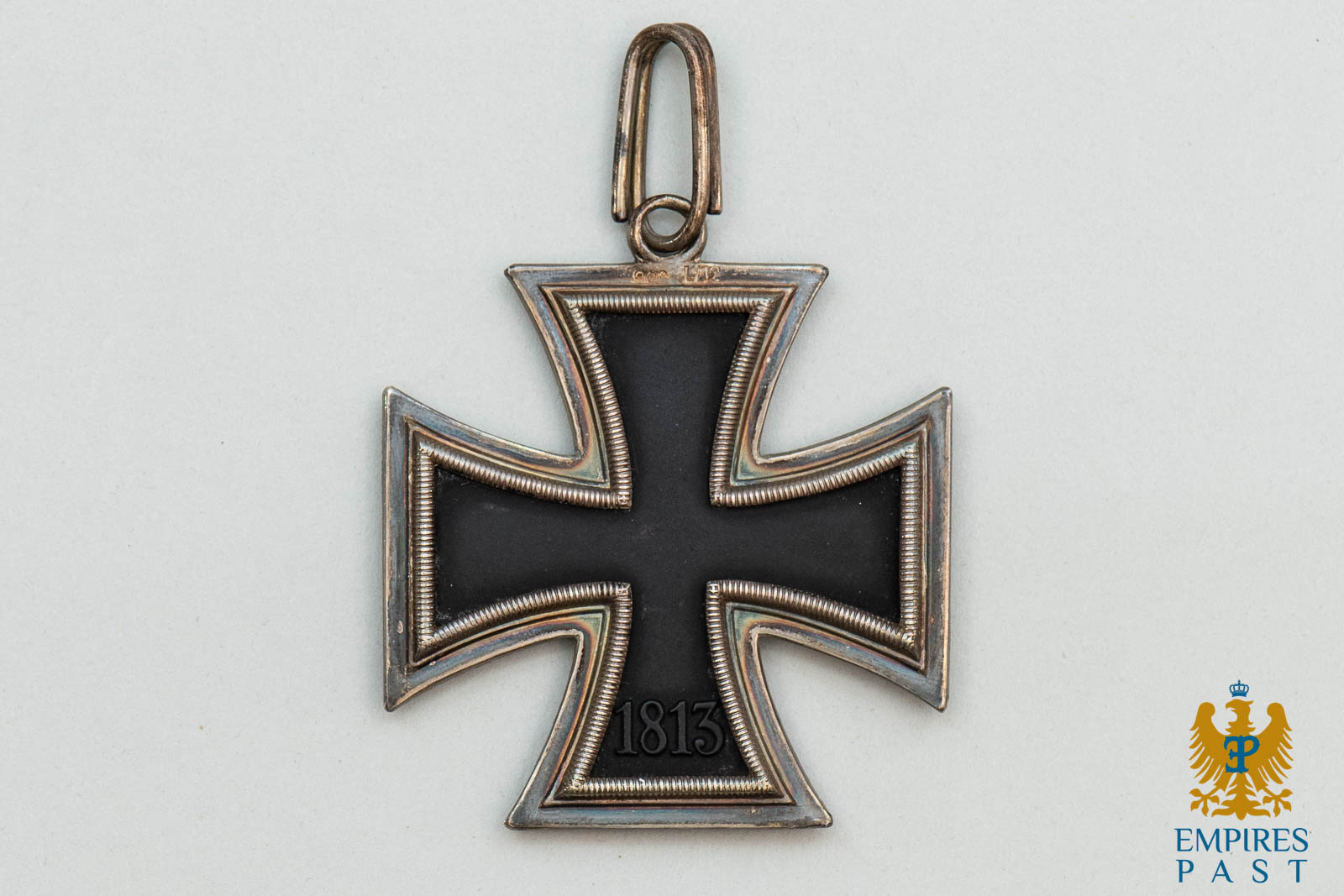
Product Description: The Cased L/12 Juncker Knights Cross is one of the most distinguishable military awards in the world, the Knights Cross is known to not only us collectors, but even the general population around the world with just a little knowledge of the Second World War recognizes this award. At the present in our collecting community, the Knights Cross is one of the most sought after awards. Of the known manufacturers of this high award, the Juncker Knights Cross stands amongst the top makers in terms of desirability and value. In recent years these crosses have all but dried up on the market, and usually when one makes its appearance on a website or a show it sells quickly. This Juncker Knights Cross rests perfectly in its original case (Etui). The case is the correct Juncker type with rounded corners, embossed borders, and the very distinct “mushroom push-button”. The case alone is a highly desirable item as it is associated with Juncker and many collectors are missing the original case for their crosses. The exterior of the case retains all of its original black leatherette with virtually no wear. The rear hinge area, still originally covered with a small piece of black leatherette, still securely holds the cases lid but with a very slight wiggle to it. The cases interior lid is lined with an artificial silk rayon, which has a few patina streaks. The base inlay, with recessing for both the cross and ribbon, is lined with a fine black velvet. The Juncker Knights Cross itself appears completely unissued, and remains in nearly perfect condition. The “800” silver frame features the textbook and widely known cross-hatching on the inner corners of the beading, a distinct Juncker trait on every single one of their crosses. The frame has developed a very mild patina due to its “800” silver content. The upper eyelet is securely affixed to the crosses frame and shows evidence of hand filing by the original skilled worker. On the upper frame of the crosses reverse, both an “800” and L/12 mark can be seen. The “800” is the mark for the silver content, and the L/12 the mark for Juncker’s LDO code. It should be noted that while the LDO marked crosses were originally intended for sale in the private purchase sector, by October 1941 the PKZ began strictly regulating the distibution of such a high award and ordered all crosses to be turned in. The core on this L/12 Juncker Knights Cross is the standard 2nd type. This core features the distinct earlier smoother “bone-black” paint. With the excepetion of a few very small nicks on the corners of the swastika and the upper corners of a few numerals, nearly all of the paint remains intact and untouched. The ribbon suspension loop connected to the crosses eyelet is stamped “800” silver. The ends of the loop are finished in typical Juncker fashion for this 1941 produced cross, with the ends showing the very slight angle from the cut after being rounded off and finished by hand filing. The full length ribbon measures 72 cm. The ribbon has minimal patina in areas, and shows evidence of being dispayed on the cross at one time. The ends of the ribbon appear to have been pinned through for display purposes at an earlier time as well. Overall this is a complete, textbook, and beautiful Cased L/12 Juncker Knights Cross. These don’t last long on the open market, don’t miss it!
Historical Description: The German Knights Cross of the Iron Cross. Instituted on September 1st, 1939, the Knights Cross has come to be known as one of the most recognized awards of World War Two and Germany. Awarded for extreme individual acts of bravery during combat, or successful battlefield leadership resulting in extraordinary success, the Knights Cross and its subsequent grades were among the German Military’s most prestigious decorations. The Knights Cross, suspended by a black, red, and white ribbon, was worn around the neck. Prior to the Knights Cross, Germany’s highest military, the Pour Le Merit, was reserved for Officers. The highest bravery awards an enlisted man could obtain was the Iron Cross 1stClass. Keeping with the National Socialist idea, and the breaking of the old Prussian aristocratic ways, Adolf Hitler created an award which, for the first time in the history of the Iron Cross, every member of Germany’s armed forces was eligible to be awarded, provided the requirements of awarding had been met. The awarding process determining whether a soldier was worthy of the award, began as a recommendation at the company level. This recommendation was then reviewed and either approved or denied. Upon approval, it would continue through the appropriate chain of command. If approval continued through unopposed, the recommendation ultimately ended in the hands Adolf Hitler, with himself making the final judgment. Most recommendations did not reach Adolf Hitler, or were lost in the chaos of war. The Knights Cross was awarded 7,364 times during the war. It is estimated that approximately 20,000 Knights Crosses were produced between September 1939 to May 1945.
Keeping with the rich heroic history of the Iron Cross, the Knights Cross was also constructed of three separate pieces, a core and two outer frames. The obverse displaying a rotating swastika in the center with the date “1939” for the year of introduction during the present conflict, and the reverse featuring only the date “1813” for the first year of the institution of the Iron Cross. The core, made of iron, zinc, or brass, was placed between the two outer silver frames and delicately hand soldered together. The cross was then suspended by a large loop through the frames top eyelet. A ribbon of black, white, and red was then threaded through the suspension loop. The production of the Knights Cross was strictly regulated, and only after the company’s granted approval by the government, were they legally allowed to produce the Knights Cross. In 1941, the German Government restricted the sale of the Knights Cross only to those with proper documentation proving their eligibility.
Wartime manufacturers of Knights Crosses are Juncker, Steinhauer & Luck, Klein & Quenzer, Otto Schickle, C.F. Zimmermann, Gebruder Godet, Unknown “3/4 Ring”.
With nearly 30 years of expertise handling, collecting, and studying some of the finest and scarcest military collectibles, Empires Past offers the best prices for your collectibles.
We purchase German, American, and Japanese Military Artifacts.
FROM SINGLE ITEMS TO ENTIRE COLLECTIONS…
WE ARE ALWAYS BUYING!!!